Our Collective Advocacy Helps Secure $2.41B for Fresh, Local School Food

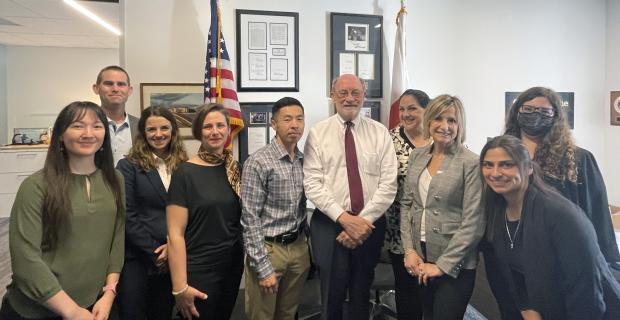
School Meals for All coalition members meet with Senator Pérez (D-Pasadena)
At the Center for Ecoliteracy, we advocate for policies that advance food justice and ensure students have equitable access to free, nutritious school meals. Our unique approach to policy change weaves stories and data to center the voices of school nutrition leaders and students.
We co-lead California’s School Meals for All coalition, which included over 225 organizations this year – a record number of organizations. Together, the coalition achieved its advocacy priorities for School Meals for All, Kitchen Infrastructure and Training, Farm to School, and the Healthy School Food Pathway program. These complementary policies ensure more students receive fresh, local school meals at a time when California families are facing an increasing affordability crisis.
Below, we offer a detailed breakdown of California’s state investment in school nutrition programs.
School Meals for All
$1.87 billion for School Meals for All, which provides free breakfast and lunch at school for California's 5.7 million TK–12 students:
- Provides an additional $2.8 million compared to the Governor’s January budget to accommodate increased student participation.
- Includes a $1.0302 per meal state reimbursement to accommodate higher costs of food and labor in California.
- Complements $2.85 billion in federal funding California receives to operate the National School Lunch and School Breakfast Programs.
Kitchen Infrastructure and Training
$500 million for Kitchen Infrastructure and Training (KIT), which supports school nutrition professionals with training and equipment to serve more freshly-prepared, locally-sourced school meals:
- In addition to the previously allowable uses around kitchen infrastructure, staff training, and California-grown food, expanded uses include on-site food pantries for students and families, as well as investments in hands-on food education, such as school garden infrastructure.
- A new funding formula takes into account whether school districts have previously received KIT funds as well as the percentage of enrolled students who qualify for federal free or reduced-price school meal benefits.
- New reporting requirements on how KIT funds are used to improve the quality of school meals (including reducing reliance on ultraprocessed foods of concern) and to increase capacity for freshly-prepared meals.
Farm to School
$24.6 million in 2026–27, $24.2 million in 2027–28, and, for the first time, ongoing funding for a permanent Farm to School program at $25.2 million annually beginning in 2028–29:
- Establishes the California Farm to School Program for the “purposes of cultivating equity, nurturing students, building climate resilience, and creating scalable and sustainable change in the school food system.”
- $20 million for the Farm to School Incubator Grant Program.
- Funds the Office of Farm to Fork's 10 permanent staff, program evaluation, and technical assistance for school districts and farmers, with a focus on climate-smart agricultural practices.
Healthy School Food Pathway Program
$14.3 million ongoing for the Healthy School Food Pathway Program to offer school nutrition staff hands-on, paid culinary apprenticeships and operational education focused on serving freshly prepared school meals:
- Most of the funding (80%) supports direct program costs, including participant instruction and training.
- New reporting requirements include employment outcomes and cost per participant.
Thank You to Our Partners
We share these advocacy achievements with our partners. The Center for Ecoliteracy co-leads the School Meal for All coalition with the American Heart Association, the California Association of Food Banks, NextGen California, and the Office of Kat Taylor. Together, we built a coalition of over 225 organizations to advocate for these priorities.
The Center for Ecoliteracy launched a California Food for California Kids® Policy Ambassador program this year to deepen input from the school nutrition community. The Policy Ambassadors – each from a different agricultural region of the state – helped shape these policy priorities and contributed their on-the-ground expertise in responding to emerging policy and advocacy opportunities.