2026 Advocacy Priorities

The Center for Ecoliteracy’s unique approach to policy change weaves stories and data to center the voices of school nutrition professionals and students. Our proposed policy solutions are informed by the school nutrition community, students, research, and the political landscape. In 2026, we endeavor to build on the landmark success of California’s School Meals for All program, providing resources and support for public school districts to address barriers in students’ access to fresh and local school meals.
Since California’s School Meals for All program began, participation in school meals has increased by nearly 9% despite declining enrollment, and students and school nutrition professionals report significantly reduced stigma. This increase in school meal participation has highlighted long-term challenges for school nutrition programs, such as staffing shortages, decades of underinvestment in school kitchen facilities, and hungry students missing or not finishing meals due to limited time to eat.
While our advocacy is focused in California, our reach spans nationwide by creating a model for transforming school food, sharing resources, and maintaining partnerships to build this movement at the state and federal levels.
Protect School Meals for All
Federal: Maximize federal funding for school meals and protect school nutrition programs from federal funding cuts.
State: Continue full funding for California’s School Meals for All program at a time when many families struggle with grocery bills.
In 2021, California became the first state in the nation to provide free breakfast and lunch to all 5.9 million TK–12 public school students, and now eight other states have followed California's leadership.
In 2025, the federal government contributed 60% of the funding for California's school nutrition programs. As students lose access to other programs like SNAP (CalFresh) and Medicaid (Medi-Cal) because of cuts in H.R. 1, schools will lose out on the federal meal reimbursement associated with these students.
School Meals for All directly addresses childhood hunger, improves the culture around school meals, and ensures that every student has the nourishment they need to learn and thrive at school. This policy is critical in California, where 44% of food-insecure families do not qualify for federal school meal assistance. New research shows that household food insecurity is 12% lower in states with free school meal programs.
"School Meals for All has opened the door for countless families who, despite facing California’s exceptionally high cost of living, never qualified for meal assistance in the past. Thanks to School Meals for All, every student now has the opportunity to enjoy healthy, delicious meals without worry or judgment." — Kat Soltanmorad, Director, RDN, Food & Nutrition Services, Tahoe Truckee Unified School District
Invest in Training and Equipment for School Nutrition Professionals
Secure new KIT program investments to increase student access to fresh and local school meals.
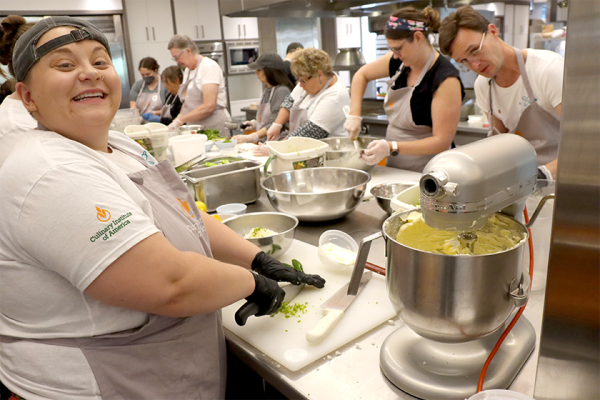
California began funding a Kitchen Infrastructure and Training (KIT) program in 2021 to allow for critical upgrades to school kitchen facilities and equipment, and enable necessary training for school nutrition professionals to serve freshly prepared meals in all stages in the flow of food. In 2020, the estimated cost to update California public school kitchen facilities and provide staff training to serve freshly-prepared school meals was $5.8 billion, this number is likely $5-8 billion today when we adjust for both inflation and the state’s $895 million investments to date. A School Meals for All Coalition survey proves this program is working — 90% of school districts used KIT funds to increase student access and/or the quality of school meals.
“The lack of kitchen facilities is the number one barrier to producing a nutritious, quality meal. None of my 17 elementary kitchens have the ability to fully cook any meals, due to the fact that they were planned 40+ years ago as facilities that would only be serving pre-packaged foods.” — Mark Chavez, Director of Nutrition, Tustin Unified School District
“Facilities are the biggest obstacle to serving more students. A lot of our kitchens were designed for "heat and go" meals, not for cooking in. Our kitchens were also not built to serve the 1,100+ lunches we need at each of our High Schools. We would be able to serve more students if the facilities matched the demand.” — Sarah Kimiecik, Director of Child Nutrition, Pleasanton Unified School District
Increase Students’ Time to Eat
Explore new pathways to remove time to eat as a barrier to accessing school meals.
Students need sufficient time to eat their school meals. Research shows that when students have at least 25 minutes for lunch, they waste less food, eat more fruits and vegetables, experience less hunger, and perform better academically. In 2025, a Center for Ecoliteracy survey showed that 76% of elementary students have less than 15 minutes to eat lunch with 25% of elementary students having just 5–9 minutes, leaving students hungry and lacking the nourishment they need to learn.
“At high schools, we serve three times as many lunches under Universal Meals than we did pre-pandemic, but have no additional time to serve lunch. The same 30 minutes and same number of serving windows, to serve triple the meals. We do our best, but lines can be long and many students still choose not to participate because they don't want to spend their lunch break waiting in line.” — Emily Cena, Director of Food and Nutrition, Poway Unified School District
Support Farm to School
Secure further investments in the Farm to School Incubator Grant Program, the California Department of Food and Agriculture Office of Farm to Fork, and solutions outlined in Planting the Seed: A Farm to School Roadmap for Success.
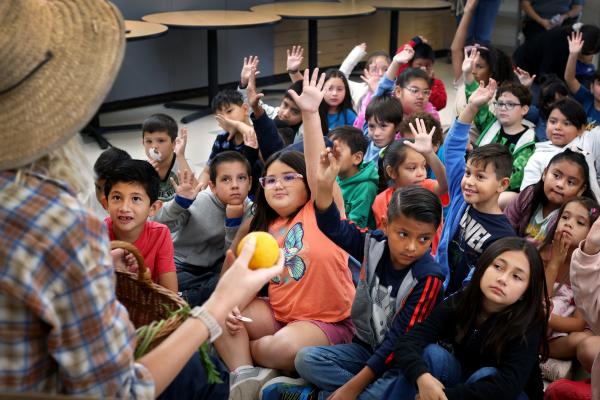
Farm to School programs increase purchases from local farmers and provide hands-on educational opportunities for students to make connections between their classroom, cafeteria, and garden. The Center for Ecoliteracy successfully advocated for a Farm to School Incubator Grant Program to be established in 2020. Farm to School leverages the buying power of California’s nearly $5 billion school food industry to support local economies, with proven increases to purchases from local farmers. A 2025 Center for Ecoliteracy survey showed that 63% of Farm to School grant recipients used grant funds to provide students with more food or nutrition education programs.
“The partnership with the Mendo-Lake Food Hub not only supports our regional agricultural economy, but also ensures our students have access to high-quality, nutritious produce.” — Melissa Kendall, Food Service Director, Shanel Valley Academy
Advance Advocacy Through Coalitions
We are stronger together. In addition to co-leading the School Meals for All and Farm to School coalitions in California, the Center for Ecoliteracy participates in the following coalitions to advance joint advocacy priorities in California and throughout the nation:
CALIFORNIA COALITIONS
California Food and Farming Network (CFFN): The Center for Ecoliteracy has been a member of CFFN since 2019. CFFN is “Building a movement centered on racial equity to transform the food and farming system through state policies.” Learn more about CFFN.
Campaign for Outdoor Learning: The Center for Ecoliteracy has been a member of the Campaign for Outdoor Learning since its inception in 2024. The Campaign for Outdoor Learning seeks to “advance sustainable statewide policy and secure funding to ensure that students spend 20-25% of their school time learning, playing, socializing, and exercising outdoors.” Learn more about the Campaign for Outdoor Learning.
Climate Ready Schools Coalition: The Center for Ecoliteracy has been a member of the Climate Ready Schools Coalition since its inception in 2023. The Climate Ready Schools Coalition “seeks to ensure that California's school buildings and grounds are developed as sites of climate resilience and decarbonization.” Learn more about the Climate Ready Schools Coalition.
School Garden Coalition: The Center for Ecoliteracy has been participating in the California School Garden Coalition since 2024. The School Garden Coalition advocates “for every California public school to have the resources, including long-term funding, to provide on-school site garden-based instruction as an equitable and cost-effective way to instill environmental literacy across all grade levels.” Learn more about the School Garden Coalition.
NATIONAL COALITIONS AND COLLABORATIONS
Center for Science in the Public Interest (CSPI), State and Local School Nutrition Policy Collaborative: The Center for Ecoliteracy has been a member of this coalition since 2020. Led by CSPI, the State/Local School Nutrition Policy Collaborative works “to collaboratively support the enactment of state and local policies that protect the health of students across the nation by codifying policies in law that require adherence to strong science-based nutritional guidance as intended by the original school meal nutrition standards established by the Healthy, Hunger-Free Kids Act of 2010, support schools in their efforts to improve the nutritional quality of meals, and increase access to meals to all students.” Learn more about CSPI.
Food Research & Action Center (FRAC), State Work Group on Healthy School Meals for All: The Center for Ecoliteracy has been participating in the work group since 2021. Led by FRAC, the State Work Group on Healthy School Meals is a space for states who are advocating for or implementing Healthy School Meals for All policies to share strategies and resources. Learn more about FRAC.
National Alliance for Nutrition & Activity (NANA) Coalition: The Center for Ecoliteracy has been a member of NANA since 2020 and serves on the Child Nutrition subcommittee. “NANA promotes, within the legislative and executive branches of government, a better understanding of the importance of healthy eating, physical activity, and obesity control to the nation's health and health-care costs. In addition, NANA aims to cultivate champions for nutrition, physical activity, and obesity prevention in Congress and federal agencies.” Learn more about the NANA Coalition.
National Farm to School Network (NFSN), Healthy School Meals for All Community of Practice: The Center for Ecoliteracy participated in the Community of Practice from 2024–2025. Led by the NFSN, this was “a collaborative space where states can collectively work towards the goal of ensuring every child has access to nutritious, values-aligned meals in schools.” One of the outcomes of this collaborative was “Farm to School and Universal Meals in California: A Case Study of AB 130.”
Voices for Healthy Kids (VFHK), School Nutrition Affinity Call: The Center for Ecoliteracy has been participating in these calls since 2024. Led by VFHK, the calls are a place to “connect with colleagues, share the latest with Healthy School Meals for All, Time to Eat, and Nutrition Standards campaigns and learn what’s happening in the school foods space."
Thank You to Our Partners
We are grateful to everyone who has contributed their time and expertise to shape the Center for Ecoliteracy’s 2026 policy priorities. These priorities are deeply informed by the school nutrition community, including the 250 school nutrition leaders (serving nearly 40% of California students) who provided their input on our policy priorities.
The Center for Ecoliteracy launched a California Food for California Kids Policy Ambassador program this year, to deepen input from the school nutrition community. The Policy Ambassadors – each from a different agricultural region of the state – helped to shape these policy priorities and will contribute their on the ground expertise in responding to emergent policy and advocacy opportunities in 2026. We are grateful for:
- Michelle Drake, Director, Food & Nutrition Services, Elk Grove Unified School District, Central Region
- Alexandra Emmott, Director of Food & Nutrition Services, Mt. Diablo Unified School District, Bay Area Region
- Pilar Gray, Director, Nutrition Services, Fort Bragg Unified School District, North Coast Region
- Amy Haessly, RDN, Director of Child Nutrition Services, Fallbrook Union Elementary School District, Southern Region
- Kristin Hilleman, Director II, Food and Nutrition, Capistrano Unified School District, Greater Los Angeles Region
- Rafael Juarez, Senior Director ‑ Food/Nutrition Services, Kern County Superintendent of Schools, San Joaquin Region
- Erin Primer, Director of Food & Nutrition Services, San Luis Coastal Unified School District, South Coast Region
- Kat Soltanmorad, RDN, Director, Food & Nutrition Services, Tahoe Truckee Unified School District, Superior Region
We cannot advocate for these priorities alone. We are deeply grateful for our co-leads in the School Meal for All Coalition: the California Association of Food Banks, NextGen California, and the Office of Kat Taylor. Dozens of school nutritional professionals and student leaders join our advocacy each year, meeting with legislators, hosting site visits, and providing public comment in Sacramento. Together, we successfully advocated in 2025 to secure over $2 billion of funding for School Meals for All, the Kitchen Infrastructure and Training Program, and other school nutrition priorities.